Case01 / 05 · Financial Valuations
ClientTivaco · Singapore
DomainHigh-stakes valuations · arbitration

Metrics from financial statements — for valuing businesses under arbitration.

The client is Tivaco, an expert firm valuing damages and assets for international arbitrations. Top-5% damages experts globally, $15B+ in valued assets. Highest claim in the portfolio — $8B+.

high-stakes valuations financial reports multi-source resolution traceability
§ a Context What's at stake

Tivaco values private companies under arbitration. The cost of error is high.

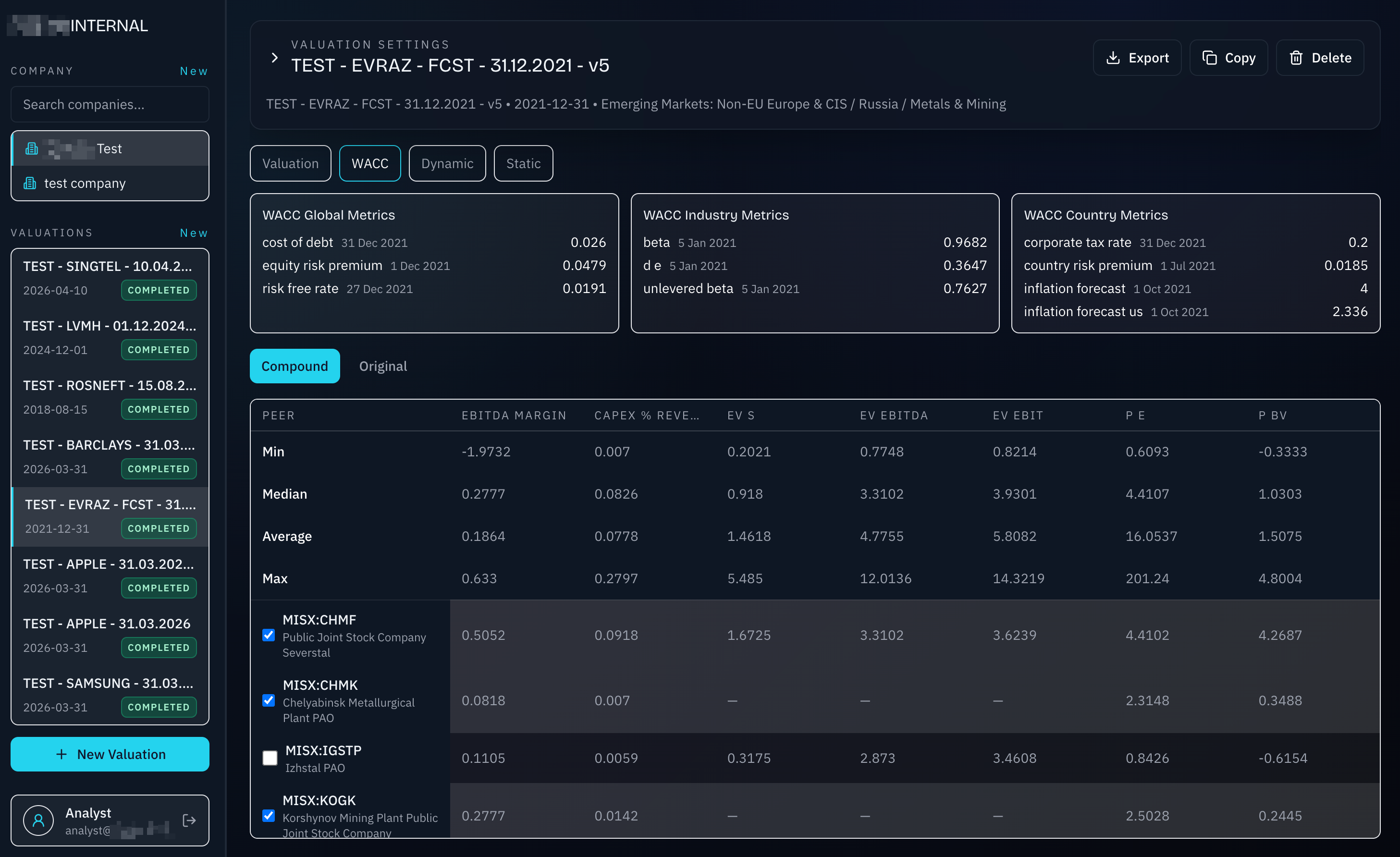
The valuation targets are private (non-public) companies. That's the key constraint: they have no direct market multiples — peers must be picked among public companies in the same geography and sector.

Before us, the work was done manually by senior analysts — $50/hour+, several days minimum per document. Financial statements run hundreds and thousands of pages, and the same metric can have several values within a single document.

The task — reliably extract financial metrics for specific dates, resolve collisions, and pull in market context.

  • a.Dozens of financial metrics from PDFs of hundreds of pages.
  • b.Metrics in three slices: historical / current / forecast.
  • c.Collision resolution with explicit reasoning.
  • d.Public peer selection and multiples gathering.
§ b What we did Under the hood

Extraction pipeline with reasoning over candidates and a UI with traceability on every figure.

Extraction pipeline built around the structure of financial statements: PDF → sections → tables → values with source context. Tables, body text, and footnotes are processed together.

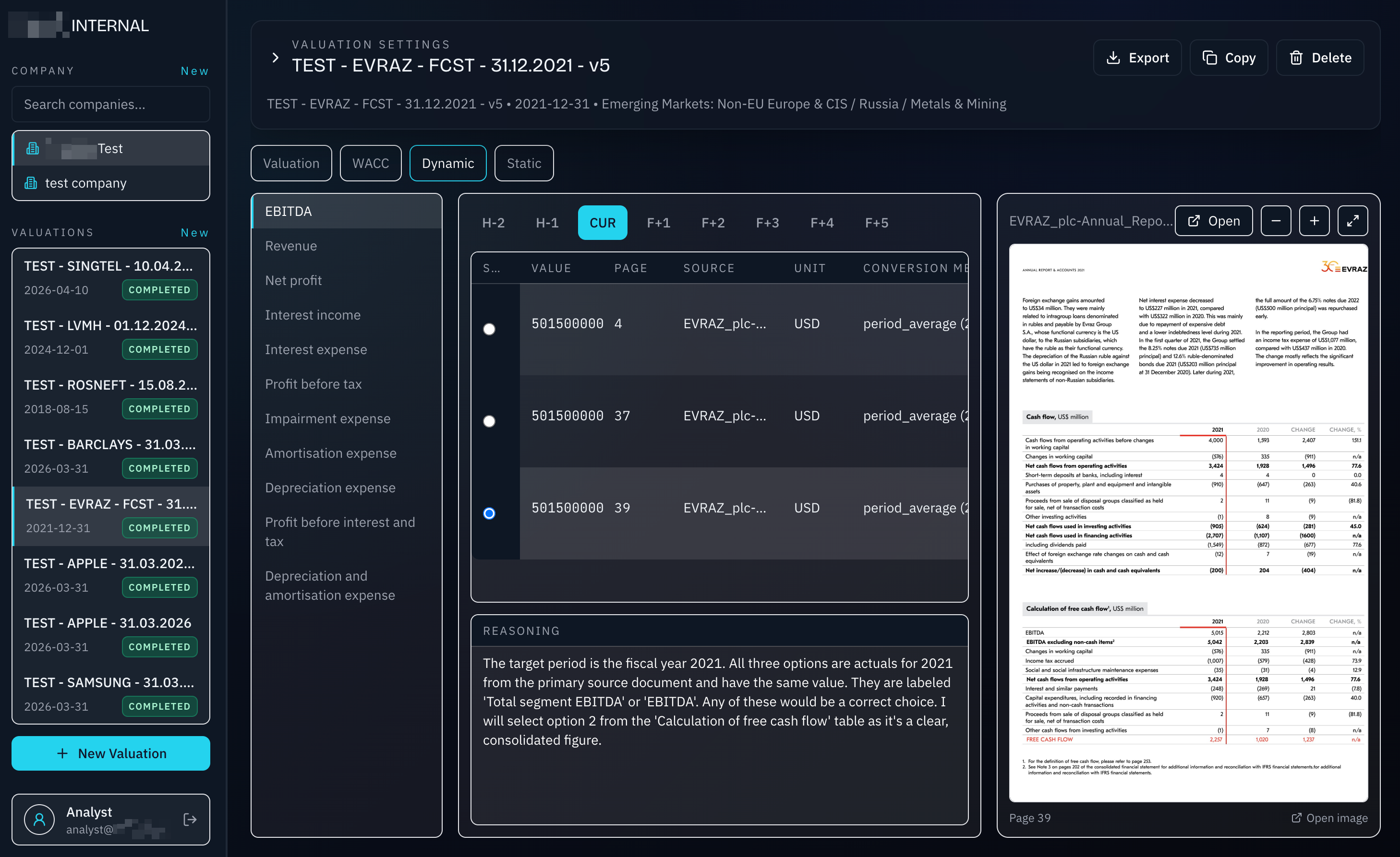
Collision resolution across multiple values found for the same metric on the same date — with reasoning explaining why a particular variant was chosen.

Temporal dimension: one metric across historical / current / forecast slices, on specific dates. Technically harder than «just pull the number»: a single metric exists in multiple slices simultaneously.

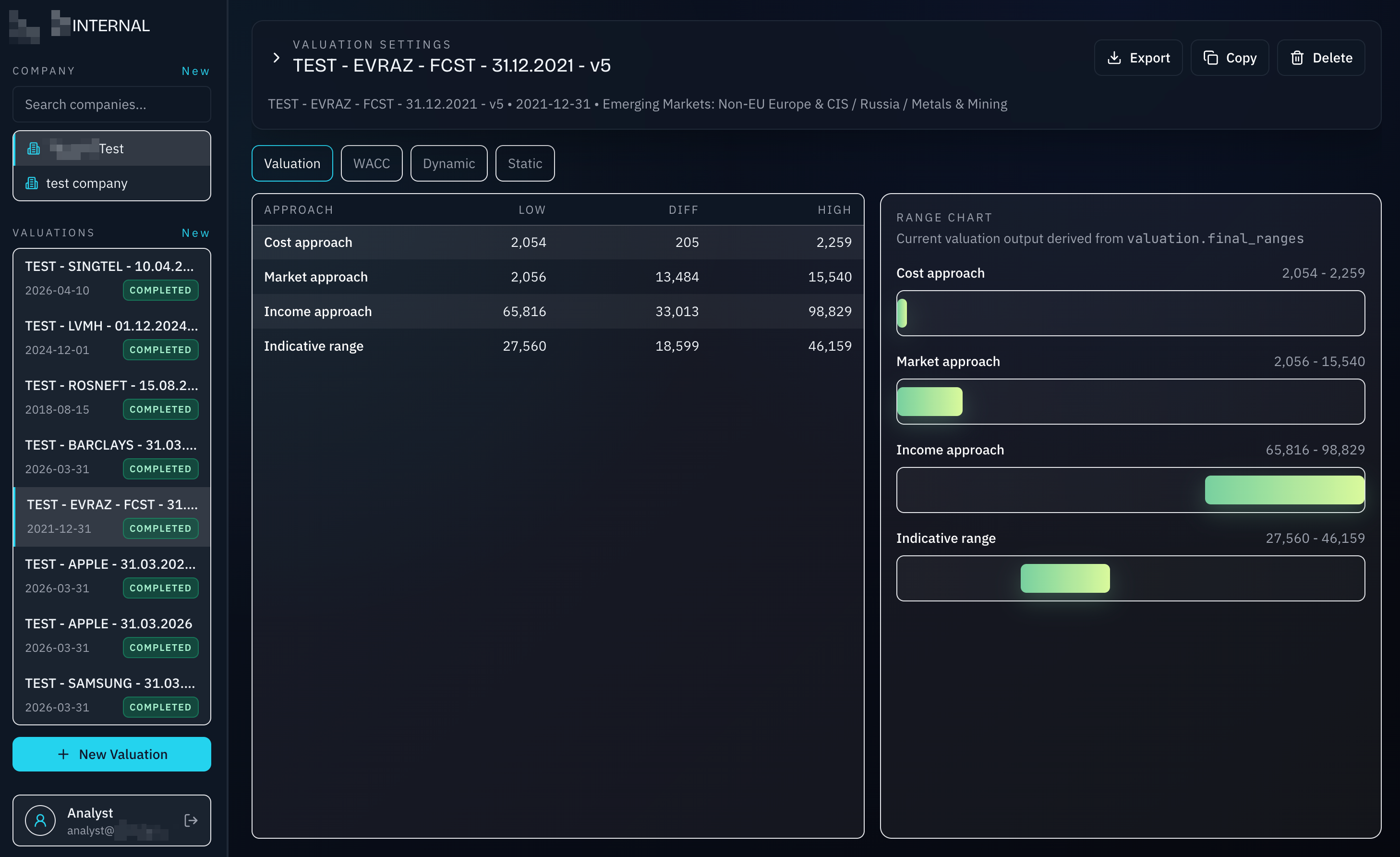
Public peer selection by geography and industry, with multiples gathered (cost / market / income approach).

Analyst UI. Every value comes with a quote from the source PDF, an explanation of the choice, and a link to the specific page. The analyst can verify, edit, accept.

The human stays the source of decision — the machine produces a defensible draft. This is critical for high stakes: every number ends up in an arbitration.
§ c Result What came out
Result
Analyzing ~10 documents fits into ~5 minutes instead of several days per document. The analyst doesn't «take AI on faith» — every number has a source, a quote, and a page. Cost per valuation case drops by cutting senior-analyst hours.
§ d Where it got tricky Under the hood
  • a.Large financial-statement PDFs — hundreds and thousands of pages.
  • b.Extraction from tables + body text + footnotes simultaneously.
  • c.Cross-document consistency for the same metric across documents.
  • d.Multi-source resolution with explicit reasoning over candidates.
  • e.Peer selection: geography + industry + multiples.
  • f.UI with traceability: quote → page → decision.

Other cases.

Similar problem?
Get in touch.

Send a brief description of what you have. From there — in correspondence: we get the context, scope the boundaries, and agree on a PoC in days–weeks.